Peptides ship as freeze-dried powder and have to be dissolved in a sterile liquid before use. A vial is then punctured many times over days or weeks, and every puncture can bring germs in. This thread covers what to dissolve in and how. Mixing BAC water yourself has its own thread: Making Your Own Bacteriostatic Water.
What BAC water is
Bacteriostatic (BAC) water is sterile water with 0.9 % benzyl alcohol (9 mg per ml). The benzyl alcohol stops bacteria from multiplying between draws. Plain sterile water has no such protection. It suppresses growth but does not reliably kill everything, so clean technique still matters, see Sterility 101.
Alternatives
- Sterile water (e.g. Ampuwa) or sterile 0.9 % saline: fine if the vial is used up within about a week and kept in the fridge. Without a preservative, neither is suitable for longer use.
- Dilute acetic acid (0.6–1 %): only for the few peptides that will not dissolve in water.
- Never: tap water, non-sterile distilled or deionised water, or anything not sealed and labelled sterile.
How long does BAC water keep?
Official pharma rule: An unopened, factory-made vial keeps until the printed expiry date. Once punctured, multi-use vials must be discarded after 28 days (USP <797>, section 14.4). This is a sterility rule for pharmacies and hospitals, not a measured expiry of the benzyl alcohol.
What the measurements say: The PTDS testing community had Hospira bacteriostatic water tested by Janoshik Analytical for 120 days, under three conditions: room temperature with a puncture only on test days, room temperature with 1 ml drawn every week (air let in each time), and fridge with 1 ml drawn every week.
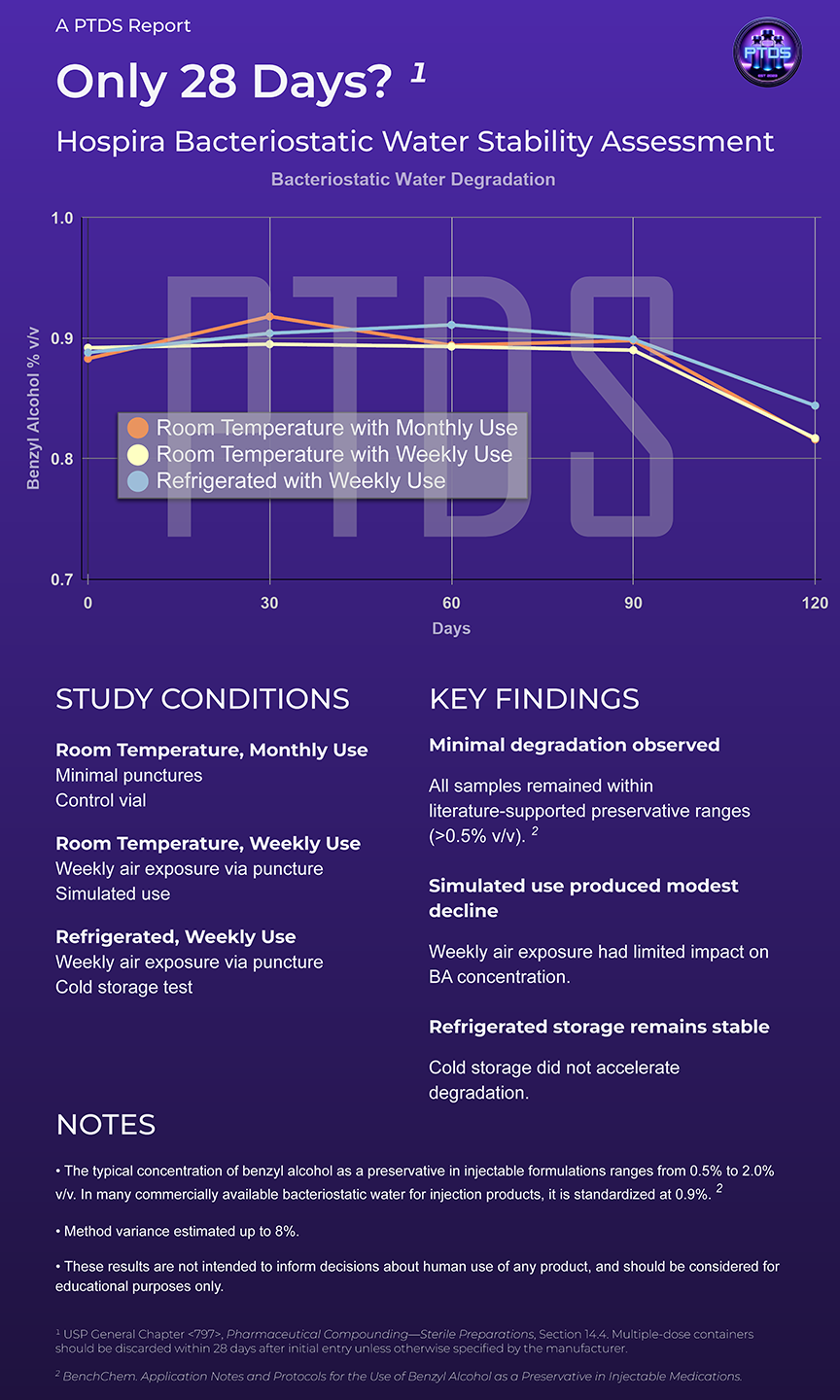
Benzyl alcohol, % (target 0.9)
Day 0 30 60 90 120
Room temp, rarely used 0.88 0.92 0.89 0.90 0.82
Room temp, weekly use 0.89 0.90 0.89 0.89 0.82
Fridge, weekly use 0.89 0.90 0.91 0.90 0.84
- Nothing happens for 90 days. At day 28 and all the way to day 90 the content is unchanged within measuring accuracy (±8 %). Weekly punctures and air made no difference.
- After day 90 it drops by 6–9 %, in all three vials, so this is slow ageing of the benzyl alcohol, not something caused by use. The fridge vial dropped least.
- Still effective at day 120. 0.82 % is far above the roughly 0.5 % below which benzyl alcohol stops working reliably as a preservative.
Limits of the data: one vial per condition, one brand, and it measures the preservative, not germs. Source: PTDS / PepRecon, "Only 28 Days?" (with raw data).
What about bacteria? With clean technique, growth is unlikely: as long as the benzyl alcohol is present, it keeps suppressing bacteria. It stops growth but does not reliably kill everything, so the real risk grows with every puncture. A fresh alcohol swab every time matters more than the date.
What happens after 90 days? The benzyl alcohol slowly oxidises, mainly from the air let in with each puncture, into benzaldehyde (smells like bitter almond) and benzoic acid, which do not preserve. That is the drop you see between day 90 and 120. It is slow, but it does mean the concentration keeps falling.
Bought ready-made BAC water? Without a production date you do not know how long it stood before it reached you. The 90 days count from mixing, not from delivery.
Discard earlier if the water turns cloudy, shows particles or flakes, or smells clearly of bitter almond.
Rule of thumb: handled cleanly, use BAC water within about 90 days of mixing, and treat the 28 days as the conservative limit for bought vials without a production date.
Why not the cheap vendor "BAC water"?
Many peptide vendors ship their own bacteriostatic water, often produced in China. You simply do not know what is in it:
- Sterility unknown. No pharmacopoeia release testing, no documented cleanroom filling. Some vials are filled and capped by hand.
- Endotoxins. Filtering does not remove bacterial residues (endotoxins). Pharma-grade sterile water is tested for exactly this.
- Benzyl alcohol content unverified. Sometimes there is too little, sometimes none at all, so it is really plain sterile water. Sometimes it is an unknown technical grade.
- Packaging and transport. Cheap rubber stoppers, weeks of shipping at unknown temperatures.
Pharmacy sterile water and pharma-grade benzyl alcohol together cost only a few euros, so there is no reason to use the unknown stuff. How to mix it: Making Your Own Bacteriostatic Water.
How to reconstitute
- Wipe the stoppers of the peptide vial and the water with an alcohol pad and let them dry.
- Draw the water with a new sterile syringe.
- Add it slowly down the inside wall of the vial, not straight onto the powder.
- Swirl or roll the vial gently until the powder is fully dissolved.
- Never shake a vial that contains peptide. Shaking can damage a dissolved peptide. Shaking is only right when mixing benzyl alcohol into water.
- Label the vial with the date and keep it in the fridge.
Sources
Part of the Grey Market Survival Guide, chapter 5.2. Questions, corrections and additions welcome below.